
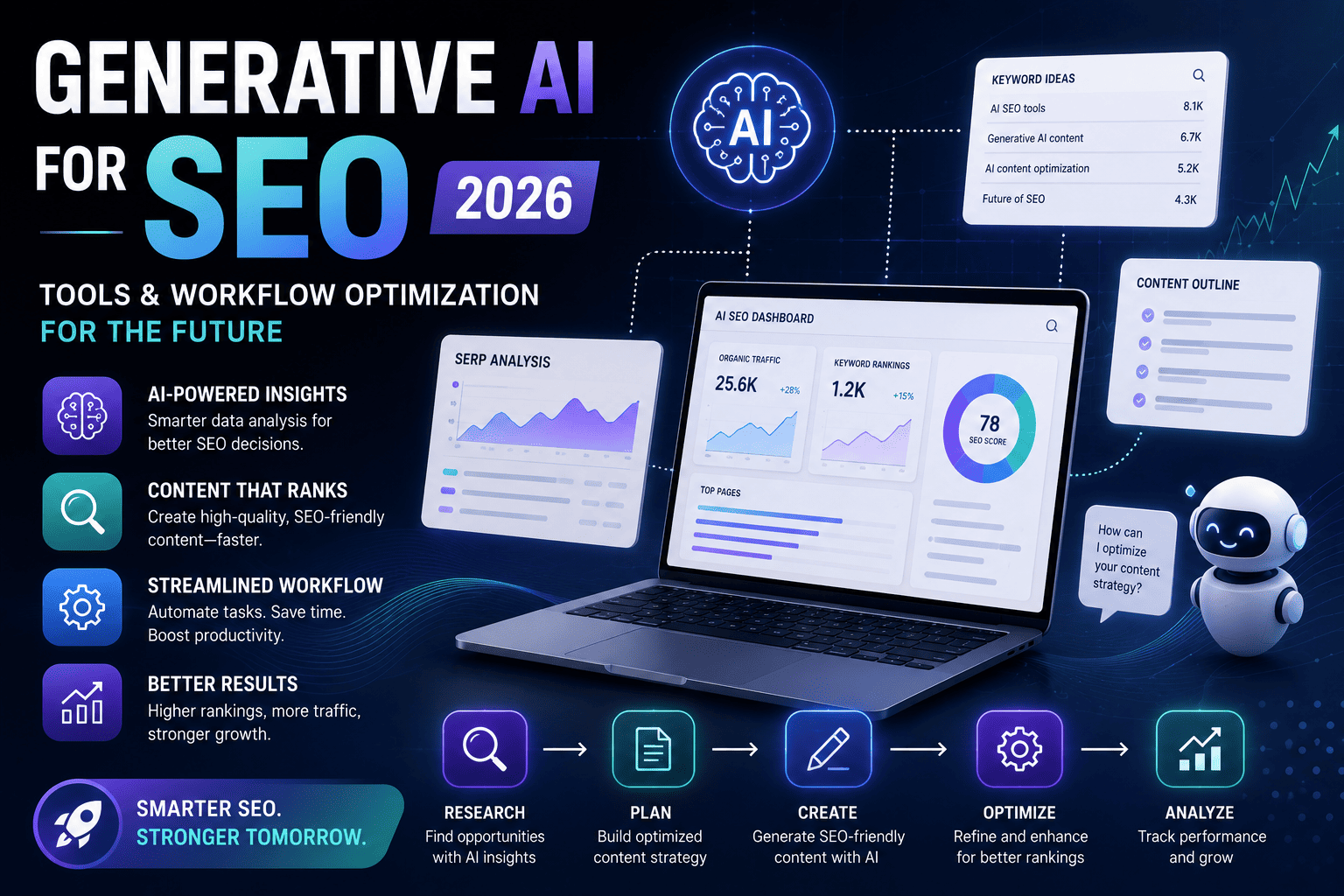
Generative AI for SEO in 2026 is fundamentally reshaping how digital marketers operate. It empowers teams to automate routine tasks, generate high-quality content at scale, conduct deep data analysis, and personalize user experiences, all while significantly streamlining workflows. The goal isn’t just efficiency; it’s about augmenting human expertise to achieve superior organic search performance.
It’s 2026, and the digital landscape we navigate has shifted dramatically. The buzz around artificial intelligence isn’t just hype anymore; it’s the bedrock of modern digital marketing. Specifically, generative AI for SEO has moved from a novel concept to an indispensable toolkit for agencies and in-house teams alike. If you’re still thinking of AI as merely a content spinner, you’re missing the bigger picture. We’re talking about a paradigm shift in how we approach keyword research, content creation, technical audits, and even competitive analysis. This isn’t just about doing things faster; it’s about doing them smarter, with a level of insight and precision that was unimaginable just a few years ago. In this article, we’ll break down the core concepts, practical applications, and future-forward strategies for leveraging generative AI for SEO to optimize your workflows and stay ahead of the curve.
Understanding the Evolution of Generative AI for SEO in 2026
Generative AI for SEO in 2026 isn’t a singular tool but a suite of advanced capabilities that go beyond simple text generation. It refers to AI models capable of creating new, original content—be it text, images, code, or even data insights—based on learned patterns from vast datasets. For SEO, this means moving past basic content outlines to sophisticated models that can predict search intent, identify content gaps, and even suggest optimal internal linking structures. It’s about leveraging AI to generate not just answers, but strategies.
The reality is, the search engines themselves are increasingly powered by generative AI. Google’s Search Generative Experience (SGE) and Bing’s Copilot are prime examples of how AI is directly influencing how users find information. This means our SEO strategies must evolve to align with these AI-driven search environments. We’re seeing AI models that can:
- Analyze millions of data points to identify emerging trends and niche keyword opportunities.
- Generate highly relevant and engaging content variations for different audience segments.
- Automate the creation of schema markup, meta descriptions, and title tags based on content analysis.
- Provide predictive insights into algorithm updates and their potential impact on rankings.
The goal is to use generative AI for SEO to augment human intelligence, allowing SEO professionals to focus on higher-level strategy and creative problem-solving rather than repetitive, time-consuming tasks.
Practical Applications: Integrating Generative AI for SEO into Your Workflow
Integrating generative AI for SEO into your daily operations can seem daunting, but it’s about identifying key areas where AI can provide significant leverage. It’s not about replacing your team, but equipping them with superpowers. Let’s look at some actionable ways to optimize your workflow:
1. Content Ideation and Creation at Scale
- Keyword Clustering & Intent Mapping: Use AI to analyze keyword lists, group semantically related terms, and infer user intent with greater accuracy. This helps you create content that truly answers user queries.
- Outline & Draft Generation: Feed your AI model a primary keyword, target audience, and desired tone. It can generate thorough outlines, section headings, and even initial drafts for blog posts, landing pages, or product descriptions.
- Content Refresh & Expansion: AI can identify underperforming content, suggest areas for expansion, and even rewrite sections to improve readability, keyword density, and E-E-A-T signals.
- Meta Data Optimization: Automatically generate compelling meta titles and descriptions that include your target keywords and encourage clicks, saving hours of manual effort.
Pro Tip: Always treat AI-generated content as a first draft. Human oversight is crucial for fact-checking, adding unique insights, and refining the brand voice. The best generative AI for SEO workflows involve a seamless handoff between machine and human.
2. Technical SEO & On-Page Optimization
- Schema Markup Generation: AI tools can analyze your content and automatically generate appropriate schema markup (e.g., Article, FAQPage, Product) to help search engines understand your content better.
- Internal Linking Suggestions: Based on content relevance and topic clusters, AI can suggest optimal internal links, improving site architecture and crawlability.
- Image Alt Text & Captions: AI can analyze images and generate descriptive alt text and captions, improving accessibility and providing additional context for search engines.
Avoiding Pitfalls and Maximizing Generative AI for SEO Impact
While the potential of generative AI for SEO is immense, there are common missteps that can hinder your progress. It’s not a magic bullet; it requires strategic implementation and careful monitoring. Here’s what to watch out for:
1. Over-Reliance and Lack of Human Oversight
The biggest mistake is assuming AI can operate autonomously. AI models, while powerful, lack true understanding and critical thinking. They can hallucinate facts, produce bland or repetitive content, and miss nuanced cultural contexts. Always have a human expert review and edit AI-generated output. This make sures accuracy, maintains brand voice, and adds the unique perspective that only human experience can provide.
2. Neglecting Prompt Engineering
The quality of AI output is directly proportional to the quality of your prompts. Learning to write clear, specific, and detailed prompts is a skill in itself. Think of it as instructing a highly intelligent but literal intern. The more context, examples, and constraints you provide, the better the results. Experiment with different prompt structures and parameters to fine-tune your generative AI for SEO tools.
3. Ethical Considerations and Transparency
As we delve deeper into generative AI for SEO, ethical considerations become paramount. Are you transparent about using AI? Are you fact-checking for bias or misinformation? Industry reports show a growing demand for transparency in AI usage. Prioritizing ethical AI practices not only builds trust with your audience but also aligns with evolving search engine guidelines.
Essential Tools and Real-World Scenarios for Generative AI for SEO
The market for generative AI for SEO tools is expanding rapidly. While specific product names can change, understanding the categories and their applications is key. Here are some types of tools and how they’re being used:
1. AI-Powered Content Creation Platforms
These platforms integrate large language models (LLMs) to assist with everything from brainstorming blog topics to drafting full articles. They often include features for keyword integration, tone adjustment, and plagiarism checks. For instance, a common scenario involves an SEO team using such a tool to generate 10 unique product descriptions in minutes, then having a copywriter refine them for brand voice and conversion.
2. Advanced Keyword Research & Clustering Tools
Beyond traditional keyword tools, AI-driven platforms can identify latent semantic relationships, predict keyword difficulty based on SERP features, and automatically cluster thousands of keywords into content topics. This helps marketers prioritize efforts and build thorough content strategies. Imagine feeding a massive list of keywords into an AI and getting back a structured content plan, complete with suggested article titles and subheadings—that’s the power of generative AI for SEO.
3. Technical SEO Auditors with AI Insights
Newer technical SEO tools are incorporating generative AI to not only identify issues but also suggest specific code-level fixes or content improvements. They can analyze site structure, internal linking, and even crawl budget efficiency, then generate actionable recommendations in plain language. This means less time diagnosing problems and more time implementing solutions.
According to recent industry data, companies adopting generative AI for SEO are reporting up to a 40% reduction in content creation time and a 25% increase in organic traffic within the first year of implementation.
SocioMav’s Approach to Generative AI for SEO
At SocioMav, we’ve been at the forefront of integrating generative AI for SEO into our client strategies since its early days. Our philosophy isn’t to replace human ingenuity but to amplify it. We see AI as a powerful co-pilot, helping our expert team deliver more impactful results, faster. In our experience, the most successful applications of generative AI for SEO come from a blended approach.
For example, we recently worked with an e-commerce client struggling with content velocity. By leveraging advanced generative AI tools, we were able to:
- Generate hundreds of unique product descriptions optimized for long-tail keywords.
- Create a robust content calendar based on AI-identified seasonal trends and user intent.
- Automate the creation of localized content variations for international markets.
This allowed the client’s internal team to focus on high-value tasks like strategic partnerships and brand storytelling, while our generative AI for SEO framework handled the heavy lifting of content production. The result? A significant increase in organic visibility and conversion rates. We believe that mastering generative AI for SEO isn’t just about using the tools; it’s about developing the strategic frameworks to deploy them effectively and ethically.
Frequently Asked Questions About Generative AI for SEO
How will generative AI for SEO change search results in 2026?
In 2026, generative AI for SEO will continue to influence search results by making them more conversational and personalized. Search Generative Experiences (SGEs) will become more prevalent, providing direct answers generated by AI, often citing multiple sources. This means SEO will shift towards optimizing for clear, concise answers and ensuring content is highly authoritative and trustworthy to be cited by AI.
Can generative AI for SEO replace human SEO specialists?
No, generative AI for SEO cannot replace human SEO specialists. Instead, it serves as a powerful assistant, automating repetitive tasks and providing data-driven insights. Human expertise remains crucial for strategic thinking, creative problem-solving, ethical oversight, prompt engineering, and maintaining a unique brand voice. AI augments, it doesn’t supplant.
What are the biggest ethical concerns with using generative AI for SEO?
The biggest ethical concerns with generative AI for SEO include the potential for misinformation or ‘hallucinations,’ lack of transparency regarding AI-generated content, copyright issues with training data, and the risk of creating generic or biased content. It’s essential to implement strong fact-checking, human review, and clear disclosure policies.
How can I get started with generative AI for SEO in my own strategy?
To get started with generative AI for SEO, begin by identifying repetitive tasks that consume significant time, such as meta description writing or content outlining. Experiment with reputable AI writing assistants or specialized SEO AI tools. Focus on learning effective prompt engineering, and always integrate a human review process to maintain quality and accuracy. Start small, learn, and scale your efforts.
The Future is Now: Embracing Generative AI for SEO
The integration of generative AI for SEO isn’t a distant future; it’s the reality of digital marketing in 2026. From automating mundane tasks to generating highly optimized content and providing predictive insights, AI is transforming how we approach organic search. It demands a shift in mindset—from fearing automation to embracing augmentation. By understanding the tools, avoiding common pitfalls, and maintaining a human-centric approach, you can leverage generative AI for SEO to significantly optimize your workflows, achieve greater efficiency, and ultimately, drive superior results. The agencies and marketers who master this synergy will be the ones who truly lead the way in the evolving digital landscape.